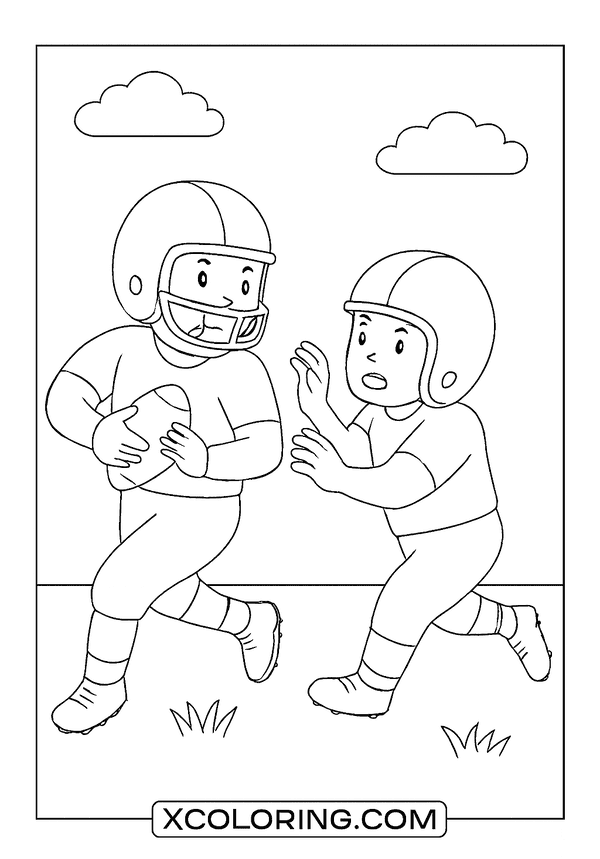
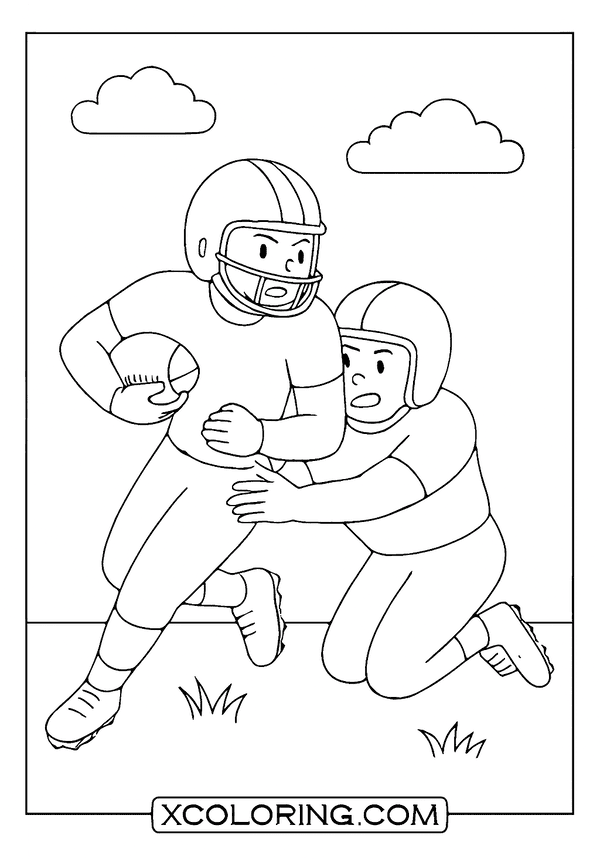
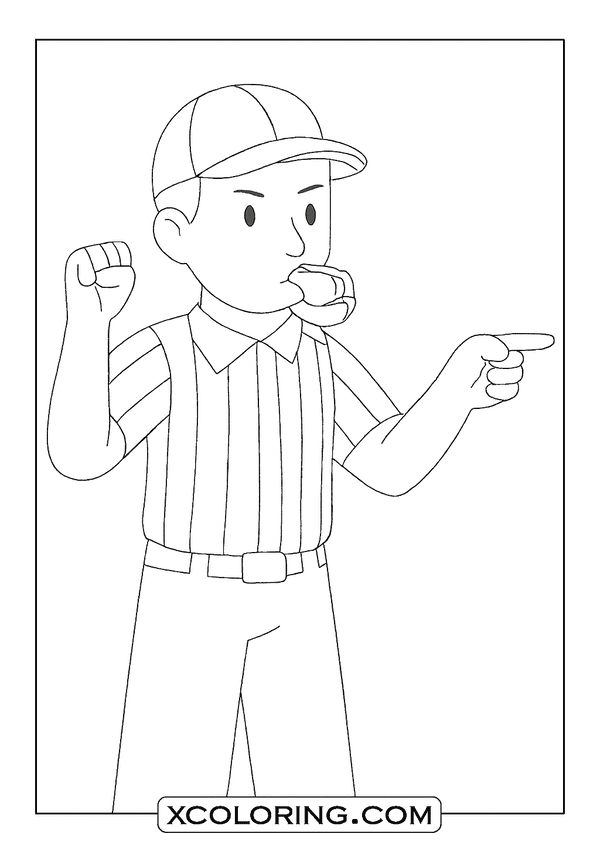
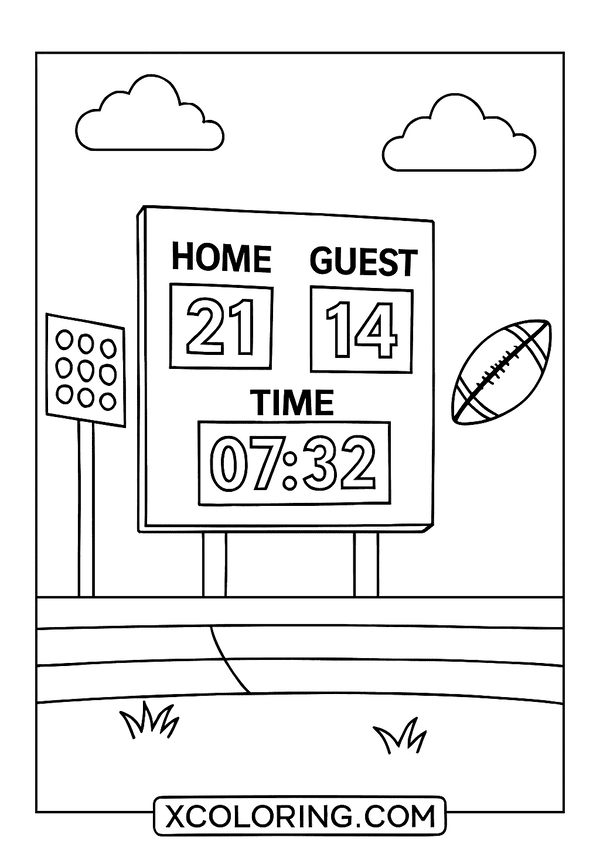
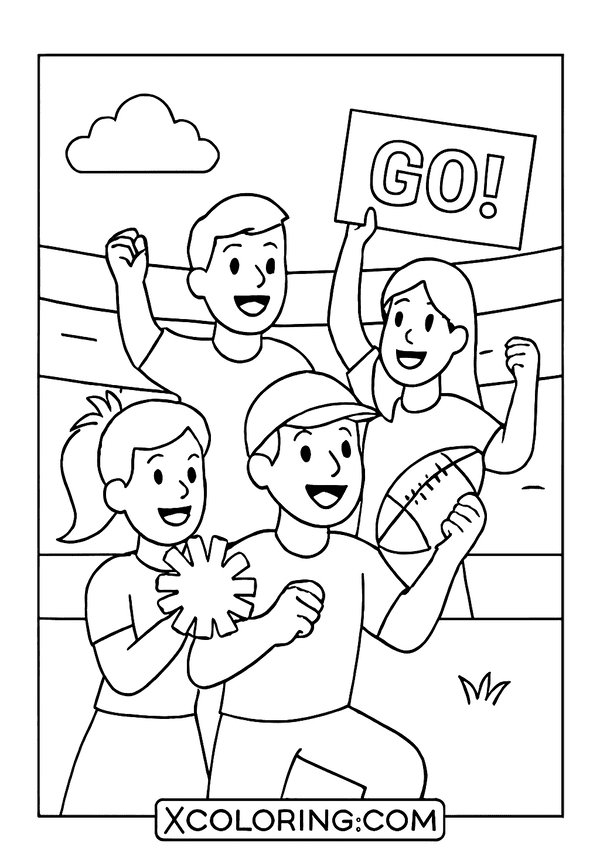
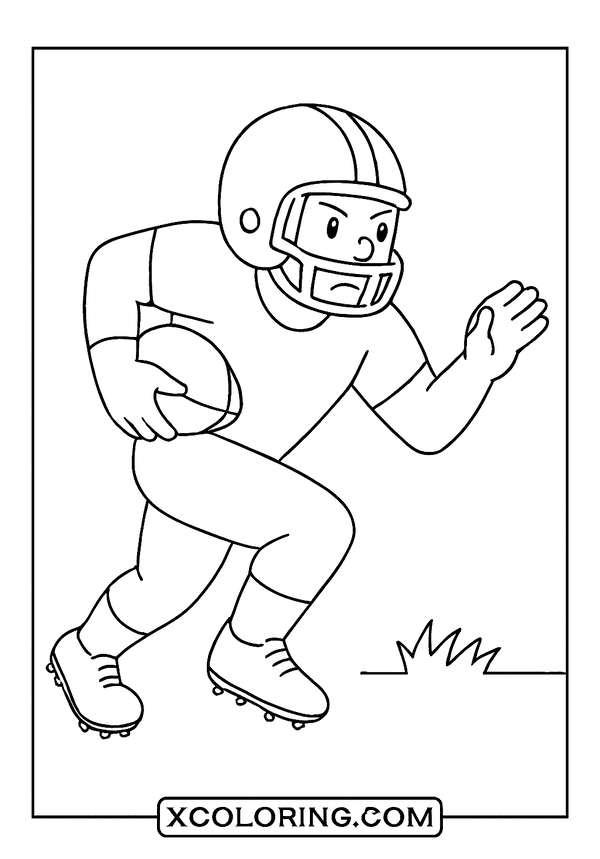
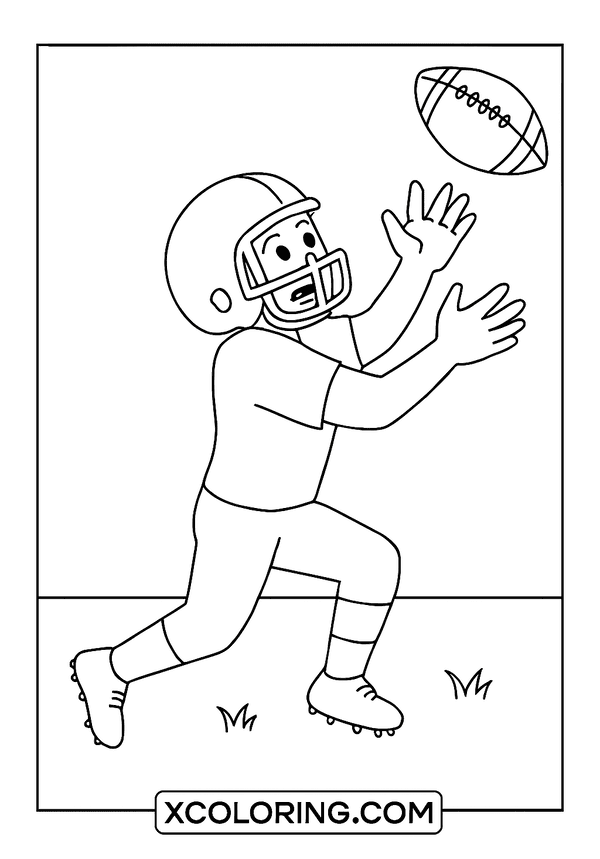
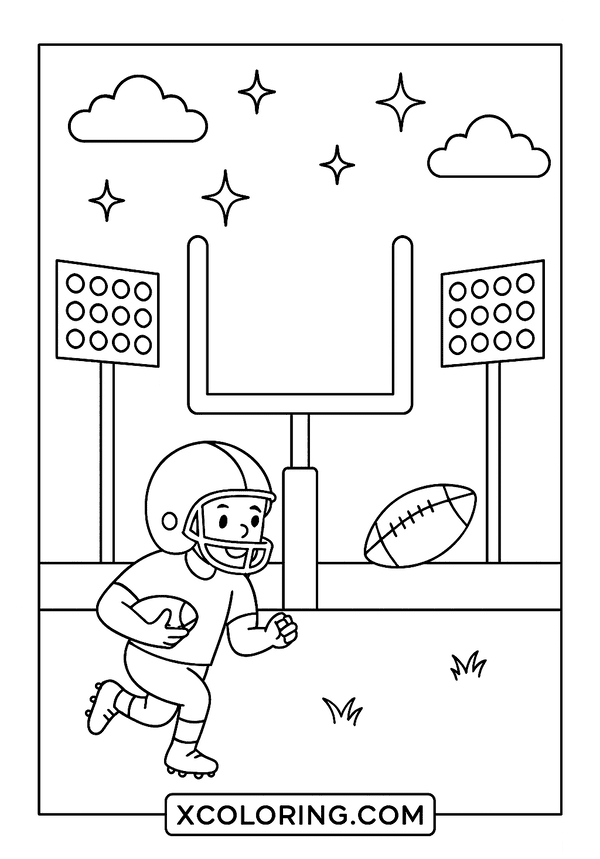
Every sheet in this collection was put together with real kids in mind, meaning thick outlines that hold up under crayon pressure, enough open space for younger hands to stay inside the lines, and details sharp enough that older kids still find them interesting to fill in. These printable football coloring pages print cleanly on standard letter paper, so there is no fiddling with settings or wasted ink trying to get a usable copy.
12 Creative Ideas for Football Coloring Pages
Coloring a football scene does not have to mean picking up a crayon and staying inside a single predictable outline. There are dozens of directions a kid or a parent could take these free football coloring pages, and the ideas below cover everything from quiet solo projects to activities built for a whole team of friends.
Full-Field Action Shot Coloring
A wide shot of a football field mid-play gives young artists a real challenge, since there is a lot happening at once between the yard lines, the players, and the ball in motion. Kids who like detail-heavy work tend to gravitate toward this kind of page because it rewards patience rather than speed.
Coloring the field itself is where a lot of the fun sneaks in. Some kids stick with realistic green and white stripes, while others turn the grass into wild patterns just because they can, and either choice teaches a bit about how shading and stripes change the way a flat drawing reads as a real space.
Layering is what separates a flat, single-tone field from one that looks like it has texture. A light green base coat followed by darker green in short strokes along the yard lines creates the kind of depth that makes even a simple football coloring sheet look more finished once the crayons come out.
Football Helmet Close-Up Designs
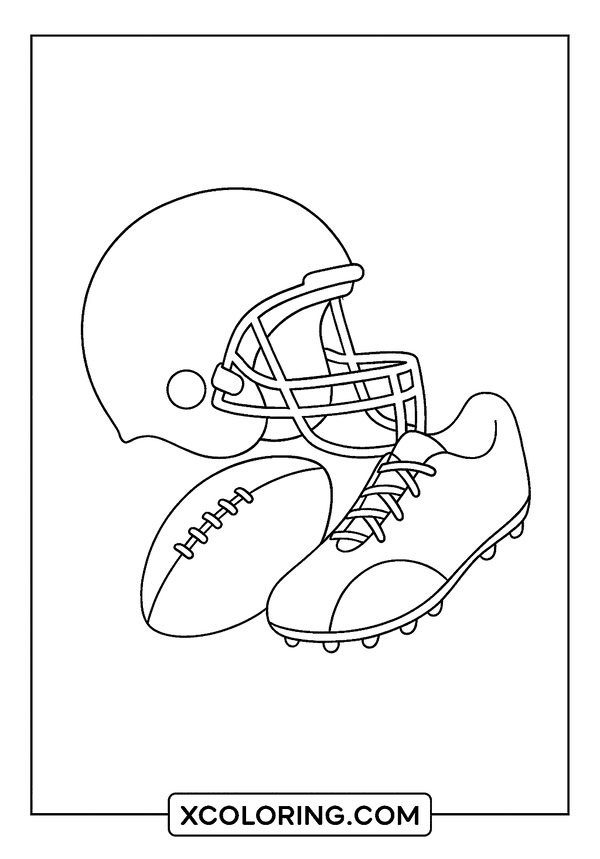
Football helmet coloring pages work well because a helmet is basically a blank canvas shaped like, well, a helmet. Kids can go the traditional route with a real NFL team's colors, or they can invent an entirely new team logo from scratch using whatever colors catch their eye that day.
The facemask bars give younger colorers a natural place to practice staying inside thin lines, which is a skill that takes real repetition to build. Older kids sometimes skip the facemask altogether and focus on shading the shell of the helmet instead, building up highlights and shadows to make it look glossy.
A helmet with a chin strap dangling loose adds a small storytelling detail that a lot of coloring sheets skip entirely. That tiny extra element gives a kid something to notice and color separately, and it is often the detail that makes a finished page feel like it belongs to a specific player rather than a generic sports logo.
Soccer Ball Pattern Practice Sheets
Soccer coloring pages built around the classic black and white pentagon pattern on a soccer ball teach geometry without ever using that word out loud. Counting the panels and figuring out which ones should stay dark creates a natural puzzle that keeps kids focused far longer than a plain circle would.
Some kids like to break from the traditional black and white scheme entirely and turn the ball into something closer to a beach ball or a marble, mixing in blues, oranges, and purples across the panels. That kind of variation is worth encouraging, since it shows a child is thinking about the pattern rather than just filling space.
A soccer ball resting on grass, with a shadow sketched underneath, gives a page a sense of weight and place that a floating ball on white paper does not have. Coloring that shadow a muted gray or brown, rather than skipping it, is a small technique that makes the whole picture feel grounded.
Team Jersey Number Customization
A blank jersey with a number already printed on it invites a kid to build an entire identity around that one digit, choosing team colors, matching socks, and sometimes even a made-up team name written along the collar. This kind of football player coloring page turns into a personal project fast.
Stripes down the sleeves or a chest stripe across the middle of the jersey give a young colorer a reason to slow down and plan their color choices before diving in, since one wrong section can throw off the whole design. That bit of forward thinking is a quiet skill builder disguised as a fun afternoon.
Kids who follow FIFA or the NFL closely sometimes try to recreate their favorite player's actual jersey from memory, right down to the trim color, and getting it close is its own small victory. Others would rather invent a jersey nobody has ever seen, and both approaches belong equally on this kind of sheet.
Goalpost and End Zone Scenes
A goalpost standing tall against an open sky is a simpler subject than a full field, which makes it a solid pick for younger kids or anyone who wants a quicker project between other activities. The tall uprights and crossbar give clean, straight lines that are easy to trace with a ruler if a kid wants extra precision.
Adding an end zone with team colors painted across the grass turns a plain goalpost sheet into something closer to a real football coloring book scene, since now there is ground detail alongside the structure itself. Blending two colors together where the end zone paint meets the regular grass is a nice technique for kids ready to move past solid single colors.
A football sailing through the uprights mid-kick gives the whole page a sense of motion that a static goalpost alone does not offer. Some kids like to add motion lines trailing behind the ball, a simple trick borrowed from comic books that instantly makes a still image feel like it is happening right now.
Mascot and Team Logo Sheets
Team mascots, whether based on real NFL teams or invented entirely for the page, give kids a character to color rather than just an object or a scene, and characters tend to hold attention longer. A snarling animal mascot or a cartoon player figure gives a young artist facial features to work with, which is a different skill than shading a flat jersey.
Logos built from geometric shapes, like stars, shields, or circles layered on top of each other, teach kids how bold outlines and negative space work together. Leaving certain sections white instead of filling every inch often makes a logo pop more than coloring the entire thing solid.
A mascot standing next to a football helmet or holding a soccer ball ties the character back to the sport itself, which matters for younger kids who might otherwise forget what the drawing is supposed to represent. That small anchor detail keeps the page feeling connected to football rather than turning into a generic cartoon animal.
Quarterback Throwing Pose Illustrations
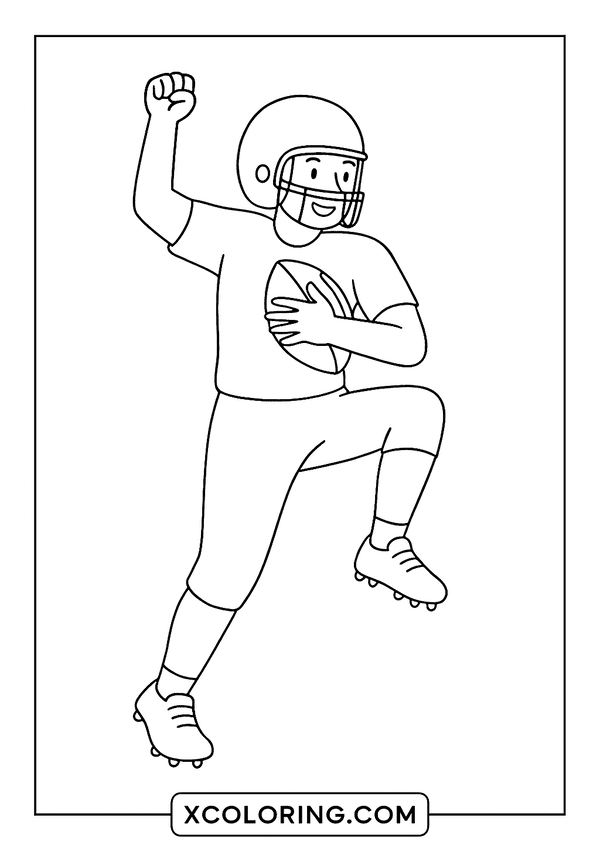
A football player caught mid-throw, arm cocked back and eyes downfield, gives older kids a chance to practice coloring a human figure in motion rather than a static object. Getting the shading right on bent arms and legs takes more attention than a flat jersey design, which makes this a good step up for kids ready for a challenge.
The uniform itself carries a lot of small details on this kind of page, from padded shoulders to striped socks to cleats dug into the turf, and each piece can be colored a slightly different shade to keep the whole figure from looking flat. Kids often enjoy picking out which parts of the uniform get the boldest colors and which stay muted.
Background crowd shapes sketched loosely behind the player add atmosphere without demanding the same careful attention as the main figure. A quick wash of color across those distant shapes, using lighter tones than the player itself, helps the eye understand which part of the picture sits in front and which sits behind.
Super Bowl Trophy and Confetti Pages
A trophy sheet built around the Super Bowl gives kids a chance to color something shiny and metallic using nothing but crayons or markers, which is a fun technical puzzle on its own. Layering silver, gray, and small touches of white in short streaks across the trophy's surface is a simple trick that mimics the look of reflected light.
Confetti scattered across the page in a dozen different colors turns a fairly simple trophy outline into a busy, celebratory scene. Kids tend to have a lot of fun picking random colors for each little confetti shape, since there is no wrong answer and no pattern to follow carefully.
Stadium lights glowing in the background, drawn as simple starburst shapes, round out the celebration mood without adding much complexity to the page. A few of these lights colored bright yellow against a darker night sky background gives the whole scene a sense of a big moment happening under the lights.
Youth League Practice Drill Scenes
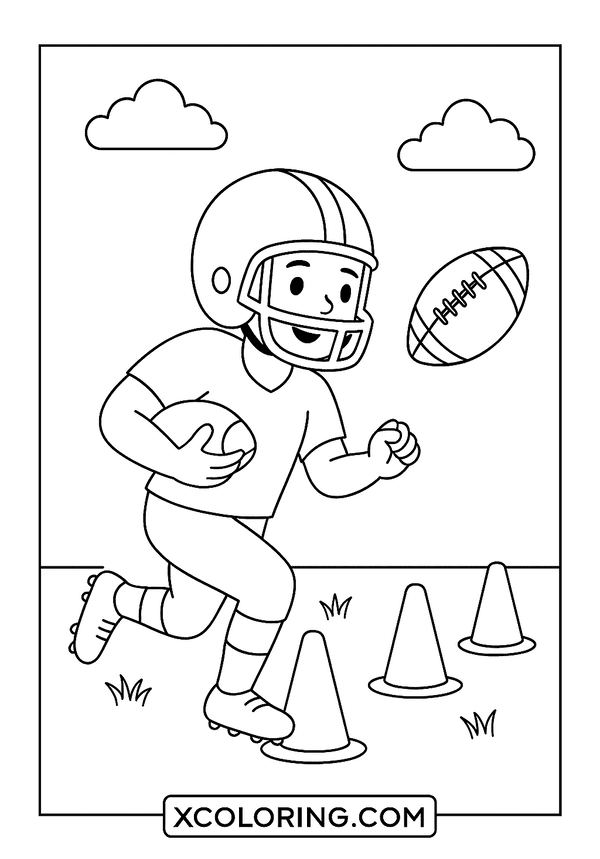
Cones lined up across a practice field, with a football player weaving between them, gives kids a coloring page rooted in the everyday side of the sport rather than only the big game moments. This kind of scene tends to resonate with kids who actually play in a youth league themselves, since it looks like their own Saturday morning practices.
Coloring each cone a different bright color, rather than matching them all, adds visual variety to what could otherwise be a repetitive row of identical shapes. Kids often enjoy turning the cone lineup into a small rainbow across the page just for the fun of it.
A coach figure standing off to the side with a whistle and clipboard rounds out the scene and gives it a bit of a story, showing that this is a moment of practice rather than a real game. That small addition helps younger kids understand the difference between a game-day scene and a training-day scene without needing anyone to explain it out loud.
Football Field Yard Line Counting Activity
Turning a simple field outline into a counting activity, where kids color every tenth yard line a different color, blends math practice into what looks like a straightforward coloring sheet. This works especially well for kids just starting to learn how a football field is measured and marked.
Numbers stenciled along the sideline, matching the actual yard markers used on a real field, give kids a chance to connect the picture to something they might recognize from watching a game. Coloring those numbers in a bold, contrasting color helps them stand out against the green of the field itself.
A small arrow or football icon placed at midfield can mark the starting point for a simple game, where kids color their way from one end zone to the other in stages. That kind of built-in structure gives the sheet a bit of extra purpose beyond just filling in color for its own sake.
Player Huddle Group Scene
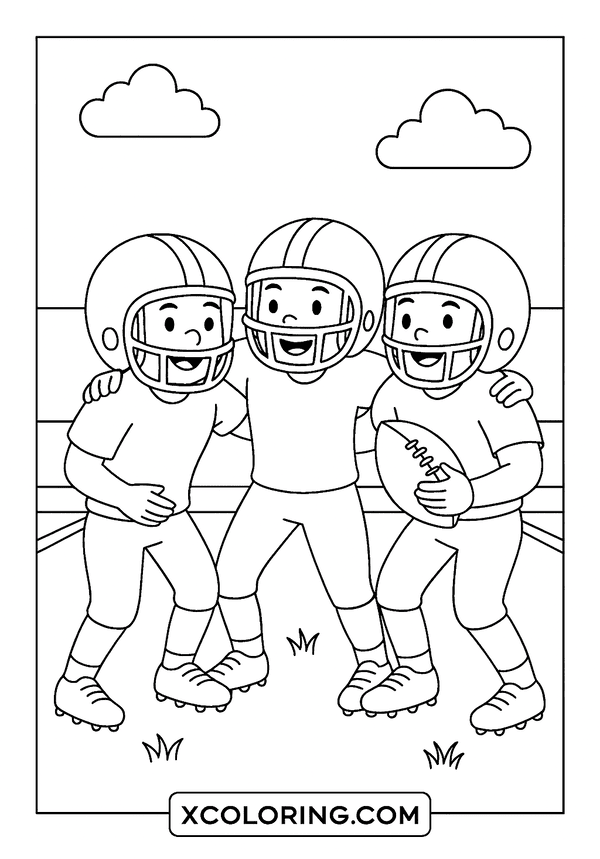
A tight circle of football players huddled together before a play gives kids a chance to color multiple figures in one scene, each wearing slightly different colored gear or facing a different direction. Working through several players in a row builds patience in a way that a single-figure page does not quite match.
Helmets tilted at different angles within the huddle add a layer of realism that keeps the scene from feeling stiff or repetitive. Coloring each helmet with the same team colors but slightly varied shading gives the group a cohesive look while still leaving room for small individual touches.
A speech bubble or simple hand gesture sketched near the center of the huddle hints at a play being called without needing any actual words on the page. Kids often fill that space with their own imagined plan, adding a layer of storytelling to what started as a straightforward group coloring exercise.
International Soccer Match Coloring Sheet
A soccer field drawn from an overhead view, complete with the center circle and penalty box lines, gives kids exposure to a different sport layout than the American football field they might be more used to. This kind of soccer coloring page works well for families who follow FIFA tournaments alongside NFL games.
Team flags placed at opposite corners of the field let kids research and color the actual colors of countries competing in a real tournament, turning the activity into a small geography lesson without it feeling like schoolwork. Picking two countries and matching their flag colors to the jerseys on the page adds an extra layer of accuracy for kids who care about getting details right.
A single soccer ball resting at midfield, drawn slightly larger than scale for visual clarity, gives the whole scene a clear focal point. Coloring that ball last, after the field and flags are finished, tends to work well since it lets kids treat it as the finishing touch on the entire composition.